Alexander the Great
-
Alright, time for the third installment in #EuropeanBios: Alexander the Great! This bio was a wild ride, full of things that were new to me. But above all, and I can't overstate this: Alexander's life was a world-spanning, never-ending, high-stakes episode of gay drama.
-
(Obviously, OBVIOUSLY, the ancient world did not have the concept of "gay" or really even homosexuality. I am nevertheless going to be throwing around words like gay, boyfriend etc. because I am not a real historian, I read history for the comedy, and can do what I want)
-
The first thing I learned about Alex, as I'm calling him from here on, is that even though I always thought he was Greek and most of the world thought of him as Greek he did not. He was Macedonian, and this distinction was very important at the time.
-
Macedonia is a region that has changed in size a lot over the years. This is a map of what it was like when Alex took over from his dad, Philip. Macedonia is the dark orange, while the people who considered themselves true Greeks are in yellow and dark blue.
-
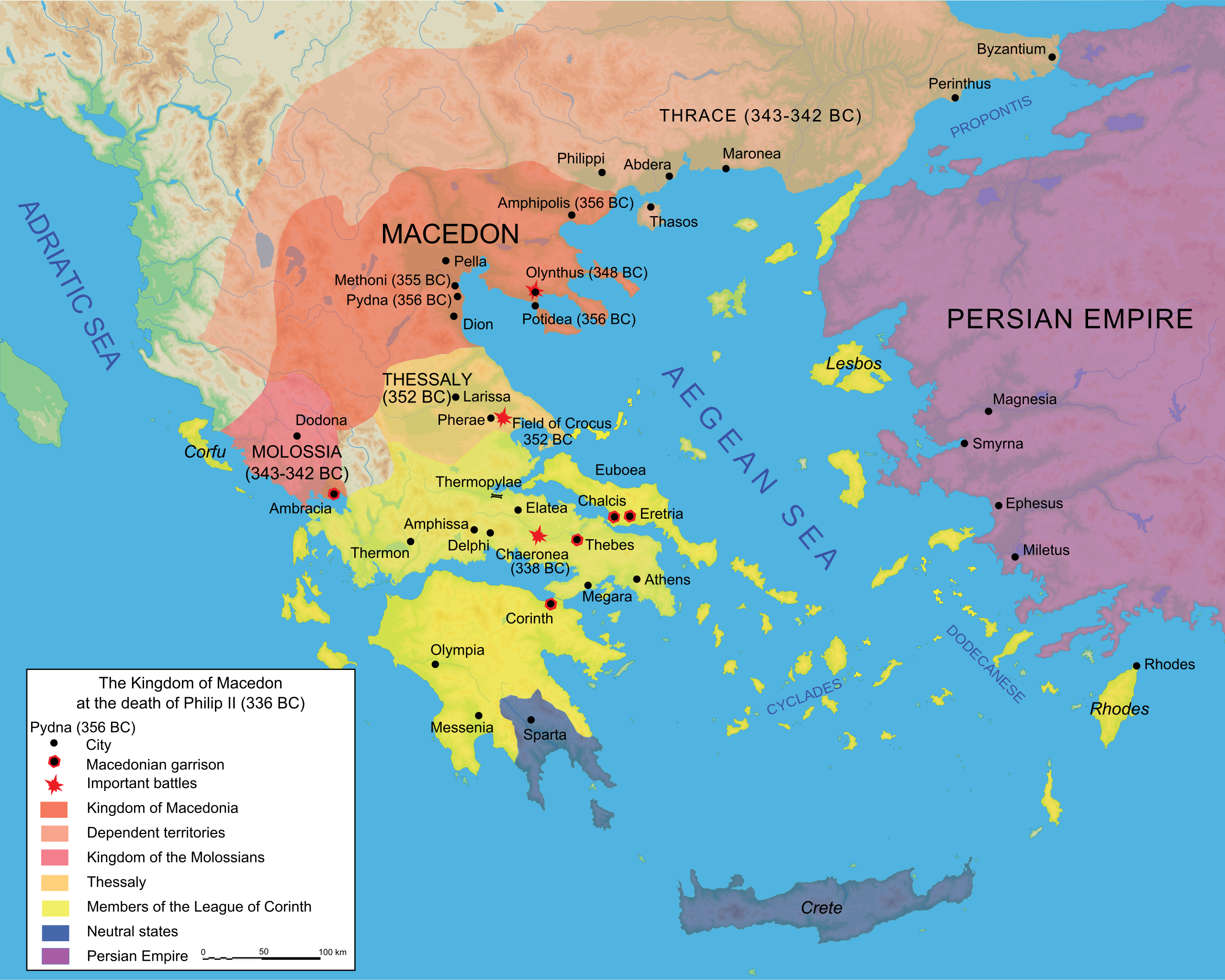
Map of the Kingdom of Macedon at the death of Philip II in 336 BC. CC BY-SA by MinisterForBadTimes via Wikimedia Commons -
The Greeks and Macedonians spoke similar languages and had a lot in common culturally but hated each other's guts. The Greeks were really snooty about the Macedonians. So when Alex spoke Greek a lot of his soldiers considered it kind of unpatriotic. This will be relevant later.
-
Alex's dad Philip was a big deal, taking the Macedonians from being a backward mountain tribe to a huge kingdom in one generation. He invented a bunch of the military strategies, techniques and technology that Alex would later use to conquer the world.
-
In particular, the military state of the art at the time were soldiers called Hoplites, who had 12-foot spears that could kill you before you could hit them with a sword. Philip defeated them by inventing 18-foot spears so he could stab them even sooner.
-
Philip and Alex conquered the Greeks in a series of famous campaigns. Of particular interest to me was the defeat of the Sacred Band of Thebes, an elite force of 150 soldiers consisting entirely of matched pairs of gay lovers. I did a double take on this!
-
But no, there are lots of credible historical sources: Thebes was defended by a fearsome band of gay couples, considered extra fearsome because they were defending their land and each other at the same time. There's delightful art.
-
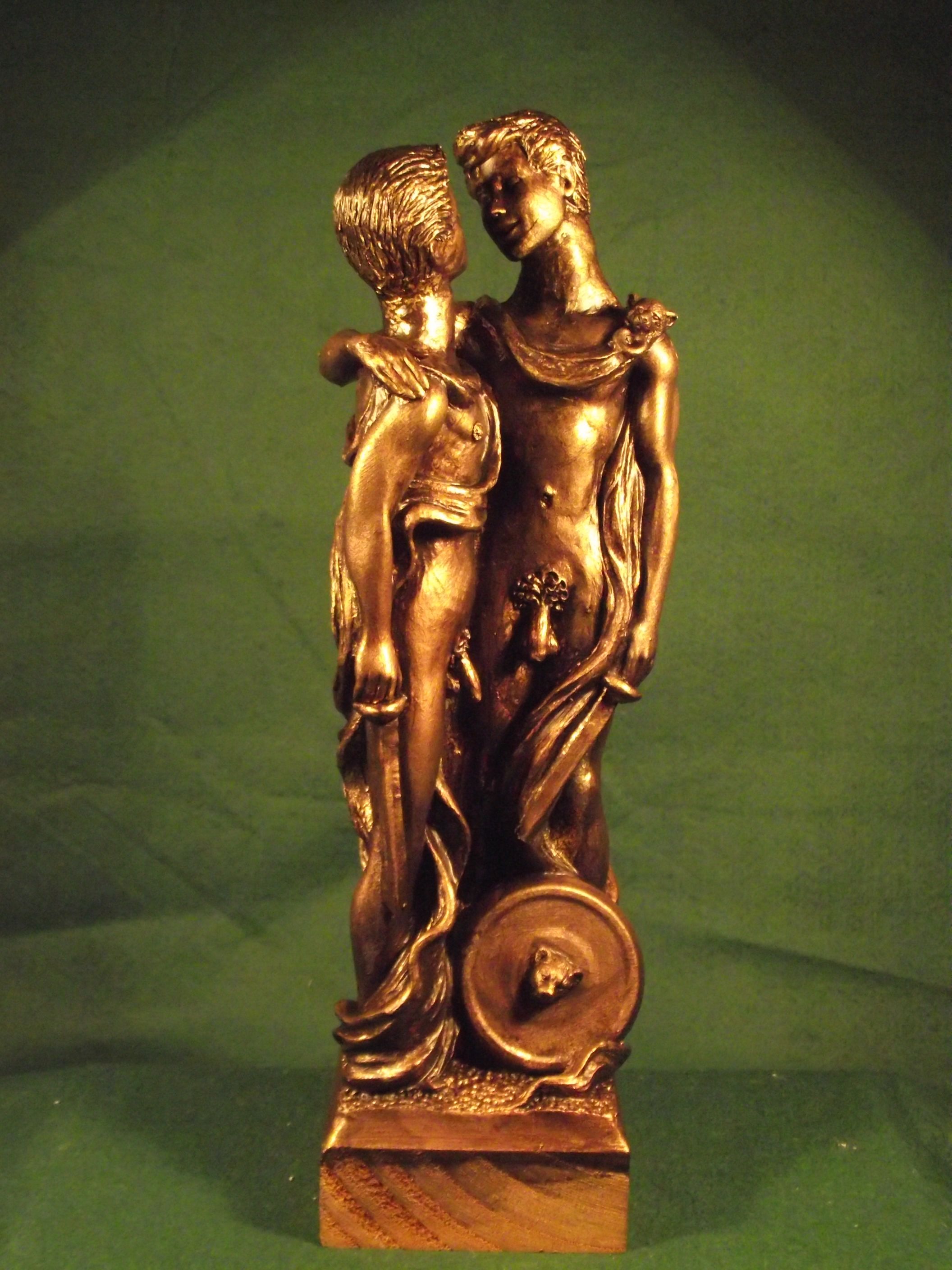
A depiction of a couple from the Sacred Band. CC BY Wikimedia user Pinkpasty. -
Philip annihilated the Sacred Band, which is a real shame, but this obviously anti-gay act was soon balanced out when Philip hit peak gay drama by being assassinated by his own ex-boyfriend.
-
Philip had been banging this dude called Pausanias but broke up with him to bang a different dude, confusingly also called Pausanias. A bunch of awful shit went down and eventually the first Pausanius, in revenge, stabbed Philip to death, making Alex king at the age of 20.
-
Given the resources of the entire kingdom to play with, Alex embarked on an absurdly long, world-spanning journey of conquest that lasted 12 years. This awesome map shows the gigantic area involved and the arrows the path he took, and what year it was at the time.
-
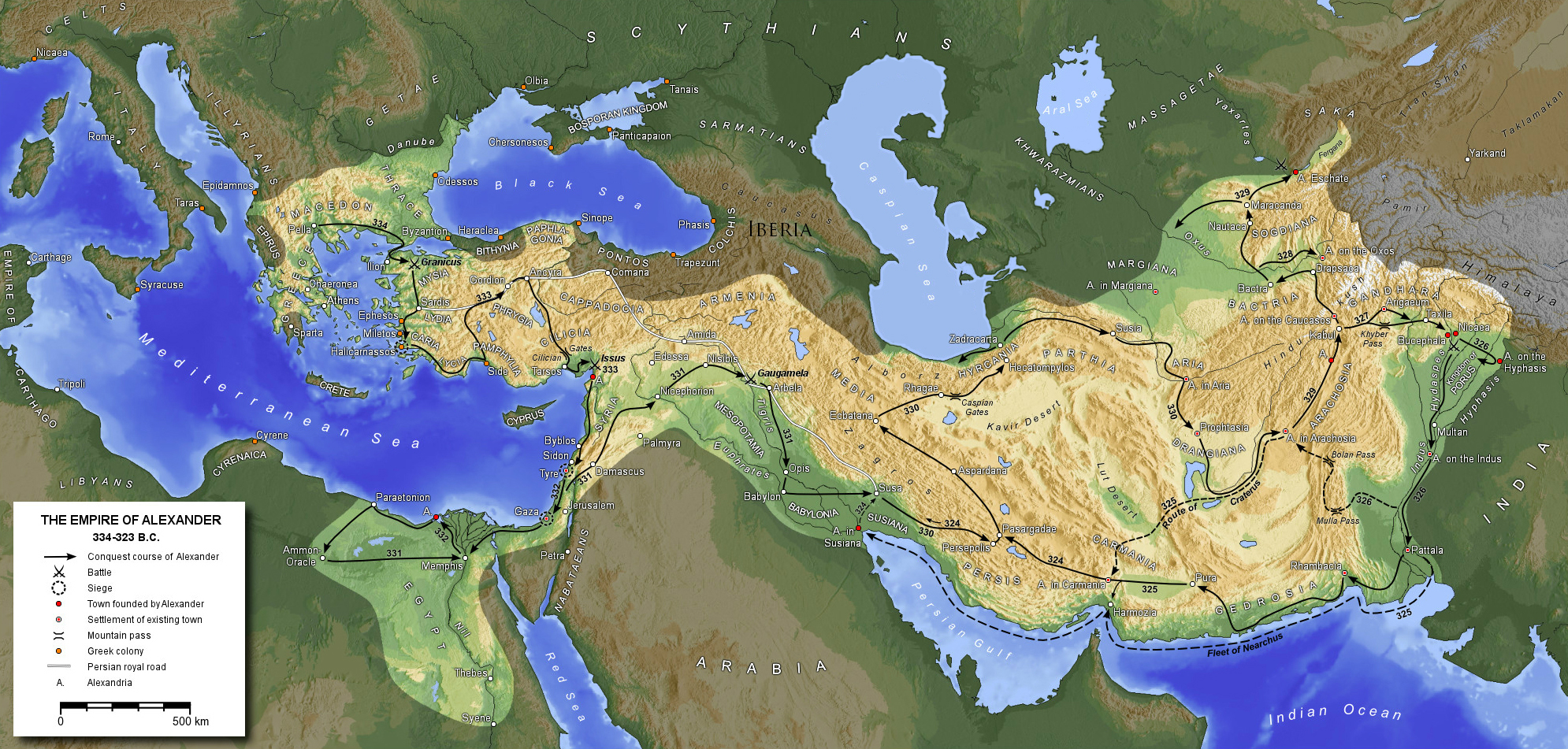
Map of conquests of Alexander the Great. CC BY-SA anonymous Wikimedia user -
If you look closely at that map you can also see red dots representing the many, many towns he founded. They are labeled "A" because they are nearly all called "Alexandria". This got confusing so the later ones have suffixes like "Alexandria on the Oxos". The one in Egypt still exists, there are two in Iraq (one called Iskandariya now). Several of the others exist but have changed names, such as Herat, Kandahar and Bagram in Afghanistan. Alexander: not a modest dude.
-
Part of his lack of modesty may be because he believed he was literally a god. Ancient times were different, superstition and faith were taken as seriously as hard facts. He spent a lot of time sacrificing to the gods and consulting oracles and soothsayers of various kinds.
-
Originally, Alex believed himself to be descended from semi-divine figures of legend: from Hercules on his dad's side, and Achilles on his mother's side. But eventually he decided being merely slightly godly wasn't enough, and so Philip wasn't really his dad, his actual dad was the god Zeus. Various oracles "confirmed" this.
-
A big part of Alex's great military success was because of his extreme bravery, not to say recklessness. And a big part of that was because he believed, because oracles had told him, both that he was invincible and that he was destined to conquer the world. They were half right!
-
Alex won an enormous number of battles. In common with Napoleon, Frederick the Great, and other hugely successful generals in history, this was less because of his strategic sense and more because he had mastered new techniques and technology that other armies hadn't yet.
-
Like Napoleon, Alex's army moved a lot faster than other armies did, mostly through force of will on his part. He also made excellent use of engineers, frequently winning battles by building bridges or ramps, or undermining defensive walls.
-
I'm not going to list his entire journey but there are some clear highlights. First up, he conquered Persia. The Greeks and Macedonians had a long-running feud with the Persians, who had conquered a bunch of Greek cities on the coast of Persia, so it was a grudge match.
-
When he started his war most people figured re-taking the Greek cities was going to be the whole war, with maybe conquering Persia as a stretch goal. Alex was just getting started. He adopted Persian royal styles and dress, irritating his rough-but-proud Macedonian soldiers, who were already annoyed about him speaking Greek.
-
Then he moved south and conquered all of Egypt, founding another Alexandria in the process. Fun fact: when Alex conquered Egypt the pyramids of Giza were already as old to him as he is to us today.
-
While conquering Persia, Alex picked up a new boyfriend, Bagoas, a eunuch who had also been the boyfriend of Darius, the king of Persia that Alex had just finished defeating. Bagoas was quite the sugar baby and was given great wealth and power by Alex.
-
I want to be clear: Alex and Bagoas were not on the down-low. Bagoas was popular with the troops, everybody knew they were fucking, and there is a famous incident where Bagoas won a dancing contest and the troops demanded Alex kiss the winner, which he did, to roars of approval.
-
In addition to multiple boyfriends, Alex also got married to women a couple of times and had some kids. As king of Persia he maintained a harem of 365 women, one for every day of the year, but he apparently didn't spend a lot of time with them and it was mostly for appearances.
-
After he finished conquering Persia proper (Turkey and Iran) he conquered the Persian provinces of Parthia and Bactria (Afghanistan and Pakistan, roughly speaking) and pressed on to India. He was beginning to conquer places the Greeks hadn't even heard of.
-
One of the stranger features of his trip is that he kept running into Greeks everywhere — little isolated bands and towns of Greek-speaking exiles and refugees were everywhere, even in India. There was a lot more travel and communication back then than I had realized.
-
Alex eventually stopped at the Ganges, mostly because his army were sick of being at war forever and his high-falutin' Persian style. They demanded he go home, so he did, but in Alexander-y fashion he went back by a different route and conquered everywhere along the way.
-
Towards the end of this campaign is when another of Alex's long-term boyfriends, Hephaestion, died of illness. Alex went famously over the top over Hephaestion, mourning for days, holding an enormous funeral and building a huge monument to him.
-
They got back as far as modern day Kuwait. Everybody wanted to continue heading back to Greece but Alex had other plans, and started making preparations to conquer Saudi Arabia and, why the hell not, all of Africa (he was not aware how big Africa was).
-
By this point his fame as a general and a warrior were so great that just the news that he intended to conquer places meant that they started sending ambassadors and preemptively surrendering. This happened across India and the middle east.
-
But instead of conquering Africa he caught a fever and, at age 32 and with no adult heir or appointed successor, he died. He had previously survived an arrow wound to the lung, numerous other grievous battle wounds, and was a heavy drinker, so honestly it's amazing he lasted so long.
-
Alex was excellent at war but was also effective at governing, capably administering his gigantic empire from afar all the time he was alive. In common with other autocrats, however, he was not good at delegation. To avoid anybody else becoming strong enough to challenge his power, he tended to put competing people in charge of the same place to prevent them cooperating.
-
He also failed to ever really integrate his empire. The Greeks still hated the Macedonians, both of them still hated the Persians, and everybody looked down on everybody else. There was no real shared identity of the "Alexandrian Empire", just a bunch of conquered territories.
-
The result was that upon his death his empire collapsed almost immediately as his competing governors scrambled for power. His wives and children were tracked down and killed, as were most of his close friends and allies. Damn.
-
In terms of legacy it's hard to beat naming dozens of towns after yourself and spreading your language and culture across the known world. Legends about him are popular across his former kingdom. Alexander is a character (specifically, a villain) in the Koran!
-
But my favorite example of his lasting impact on the world: try typing "Bucephalus" on your iPhone. 2,350 years after his death, the supercomputer in your pocket knows the name of Alex's favorite horse and will auto-complete it. His horse. That's fame to spare.
- Previously: Aristotle and Plato
- Next: Archimedes
- Full list
Text and images copyright © 2020-2023 Laurie Voss
except where indicated
except where indicated